
Setting Up Utilization Equipment for Entertainment: Luminaires, Video, Audio, Automation, and Special Effects
Setting up utilization equipment — every luminaire, projector, amplifier, automation motor, and effects device — is the production-specific phase of an entertainment electrical system setup. Unlike distribution equipment setup, which follows a generic procedure, utilization equipment setup varies by equipment type and integrates electrical connection with physical positioning, control addressing, and functional testing. Domain 1C covers the systematic approach to setting up each major equipment category.
The Universal Setup Sequence
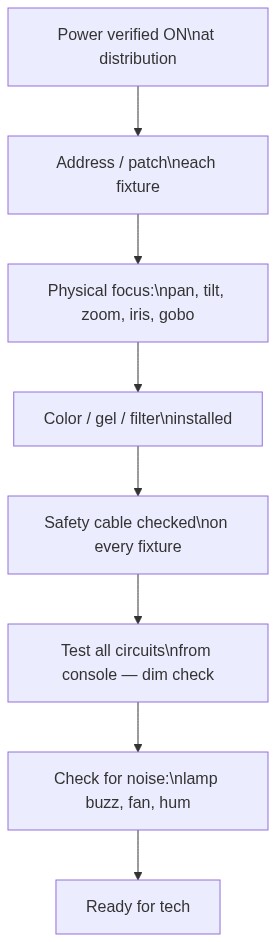
Regardless of equipment type, all utilization equipment follows the same logical progression: physical installation first, then electrical connection, then control configuration, then functional test. Skipping steps — particularly safety checks and functional tests — creates problems that must be corrected under time pressure during tech rehearsal (NFPA, 2023).
Lighting Equipment Setup
Conventional (incandescent/halogen) luminaires are the simplest to set up electrically: hang, connect to a stage pin circuit, set the gel frame and color, and perform the safety cable check. The setup challenge is the patch — the mapping between physical circuits, dimmer rack outputs, and console addresses. A patch error (a fixture addressed to the wrong dimmer) is invisible until a cue fires and the wrong fixture responds. Best practice is a systematic dim-check: take each circuit to full intensity from the console and visually confirm the correct fixture responds (NFPA, 2023).
LED luminaires add DMX addressing to the setup process. Each LED fixture must be set to a unique DMX starting address, and the control mode (standard, pixel, CCT, RGBW) must match the console fixture profile. Setting up LED fixtures on a dimmer circuit rather than a relay circuit causes problems: the chopped waveform from the dimmer interferes with the LED’s internal power supply, producing flicker, early failure, or no response. Always verify LED fixtures are on relay circuits before the dim-check.
Moving lights require a home position after power-on: the fixture runs a reset sequence that calibrates pan, tilt, and all internal motor positions. A moving light that does not complete its reset is not ready for programming. DMX address conflicts — two fixtures with the same starting address — cause both to respond to commands intended for one, a problem that must be caught during setup, not during tech. After reset, verify that pan and tilt orientation matches the console’s expectation; many moving lights require pan/tilt invert settings to match a specific hanging orientation (NFPA, 2023).
Video and Projection Setup
HID (high-intensity discharge) projectors require a warm-up period after power-on before reaching full output — typically 10–15 minutes. During this period, the lamp arc stabilizes and color temperature reaches its rated value. Operating the projector during this period is normal; do not expect full brightness or correct color immediately. More critically: HID projectors require a cool-down period after shutdown before power is removed. If power is removed from a hot HID projector, the heat inside the lamp housing has nowhere to dissipate through the cooling fan, and the lamp envelope can reach temperatures that cause catastrophic lamp failure. Most projectors have a built-in delay that keeps the cooling fan running after the lamp is extinguished; power should not be removed until the fan stops on its own.
LED video walls consist of many individual panel tiles connected in data chains. Each chain has a data input and a data output (looping connection). If one panel fails or is disconnected, all panels downstream in the chain lose signal. Setup must verify the complete data chain before content is loaded. Panel brightness and white-point calibration are performed after the data chain is verified and all panels are displaying content.
Audio System Setup
Audio amplifier racks must be powered using a sequencer that brings amplifiers online with a time delay between each. The sequencer is programmed for a specific on-delay (typically 1–3 seconds per amplifier rack) and off-delay (amps powered down before signal processors and consoles, preventing pop through speakers). The power-off sequence is the reverse of power-on: signal sources off first, amps last.
After powering up, verify each amplifier output with a tone signal before any public audience arrives. Speaker polarity (phase) must be consistent across all cabinets; a reversed polarity connection on one speaker causes it to push when others pull, reducing bass output and potentially causing harmful phasing artifacts.
Automation and Effects Setup
Automation equipment (hoists, turntables, lifts) must have the e-stop circuit tested before any motion. This test is not optional and should be documented: press the e-stop, verify all motion stops, and note the test in the production’s setup log. Set software soft limits on each axis before any travel beyond the home position. Soft limits prevent the equipment from traveling into a mechanical stop at speed, which can damage both the equipment and the load (Entertainment Services and Technology Association [ESTA], 2019).
Fog and haze machines require a warm-up period (typically 5–15 minutes) before they can produce output. Check fluid level before warm-up — running a fog machine dry burns out the heating element and can start a fire. Position output nozzles clear of electrical equipment and hot lamp housings.
Setup Reference by Equipment Type
Earley, M. W., Sargent, J. S., Sheehan, J. V., & Buss, E. W. (2008). National Electrical Code handbook (11th ed.). National Fire Protection Association.
Jones, R. A., Mastrullo, K. G., & Jones, J. G. (2004). NFPA 70E handbook for electrical safety in the workplace. National Fire Protection Association.
Occupational Safety and Health Administration. (n.d.). 29 CFR 1910 subpart S: Electrical. U.S. Department of Labor.
International Association of Electrical Inspectors. (2001). Soares book on grounding (8th ed.). IAEI.
Box, H. C. (2010). Set lighting technician’s handbook: Film lighting equipment, practice, and electrical distribution (4th ed.). Focal Press.
Hart, G. V., & Hart, S. (2008). Ugly’s electrical references. Burleson Distributing Corp.
References
Earley, M. W., Sargent, J. S., Sheehan, J. V., & Buss, E. W. (2008). National Electrical Code handbook (11th ed.). National Fire Protection Association.
Jones, R. A., Mastrullo, K. G., & Jones, J. G. (2004). NFPA 70E handbook for electrical safety in the workplace. National Fire Protection Association.
Occupational Safety and Health Administration. (n.d.). 29 CFR 1910 subpart S: Electrical. U.S. Department of Labor.
International Association of Electrical Inspectors. (2001). Soares book on grounding (8th ed.). IAEI.
Box, H. C. (2010). Set lighting technician’s handbook: Film lighting equipment, practice, and electrical distribution (4th ed.). Focal Press.
Hart, G. V., & Hart, S. (2008). Ugly’s electrical references. Burleson Distributing Corp.
See Also:
- Entertainment Utilization Equipment: Luminaires, Video, Audio, Automation, Effects, and Network Systems
- Audio Visual Equipment Safety in the Performing Arts
- Calculating Weight Distributions of Overhead Electrical Equipment for Entertainment Rigging
- ETCP Electrician Exam 1C: Setting Up Entertainment Electrical Systems