
Advanced Lighting Control Protocols: sACN, Art-Net, and RDM — ETCP Domain 1D
Beyond basic DMX512, modern entertainment productions rely on a suite of IP-based and specialized protocols. Skilled electricians must know working knowledge of these protocols, their applications, and how they interact in complex system architectures.
sACN — Streaming Architecture for Control Networks (ANSI E1.31)
sACN is the ESTA/ANSI standard for transporting DMX512 data over Ethernet. It has become the primary lighting network protocol on most professional productions.
Technical Specifications
- Transport: UDP/IP — multicast (default) or unicast
- Universes: 1 to 63,999
- Packet rate: Up to 44 packets/second per universe
- Priority: Each source has a priority value (0–200, default 100); the highest-priority source for each universe wins
- Multicast address: 239.255.x.x where x.x encodes the universe number
Priority System
sACN’s priority system enables elegant multi-source architectures. A backup console can transmit at priority 90 while the primary console runs at priority 100. If the primary fails, the backup automatically takes over without any operator action—the network resolves the conflict by priority alone.
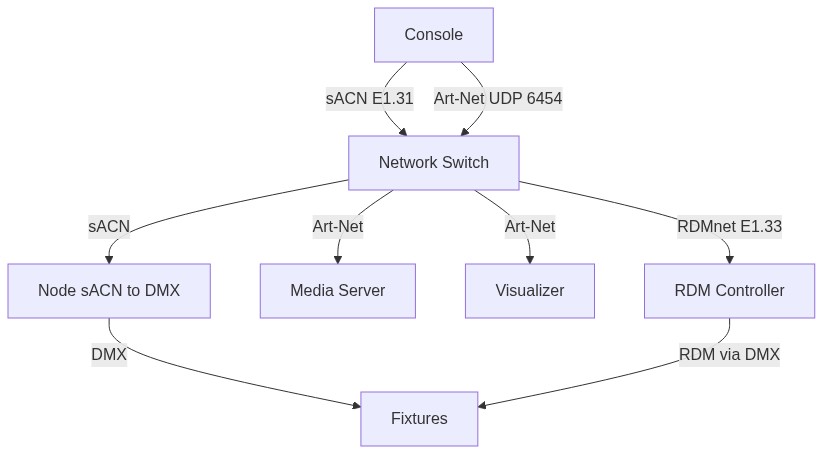
Art-Net
Art-Net was developed by Artistic Licence and released as an open specification. It predates sACN and remains widely deployed in nodes, media servers, and visualizer software.
| Feature | sACN (E1.31) | Art-Net 4 |
|---|---|---|
| Standard body | ESTA/ANSI | Artistic Licence (open spec) |
| Transport | UDP multicast or unicast | UDP broadcast or unicast |
| UDP Port | 5568 | 6454 |
| Max universes | 63,999 | 32,768 |
| Priority resolution | Yes (0–200 per source) | No (node-level merge only) |
| IGMP snooping benefit | High (multicast-based) | Moderate (broadcast-based) |
| Common applications | Console output, touring | Nodes, media servers, pixel mapping |
Art-Net broadcast mode: The original Art-Net specification used Layer 2 broadcast, flooding packets to every device on the subnet. This works on small networks but saturates large ones. Art-Net 4 introduced full unicast support, which should be used on networks with more than a few dozen devices.
RDM — Remote Device Management (ANSI E1.20)
RDM extends DMX512 with bidirectional communication. Covered in detail in the DMX512/RDM Distribution Systems article, RDM is worth noting here in the context of IP networks:
RDMnet (ANSI E1.33)
RDMnet extends the RDM device-management concept to IP networks. It allows RDM discovery and control across sACN/Ethernet infrastructure, not just along DMX cable runs. ETC Net3 nodes, Pathway nodes, and some consoles support RDMnet, enabling remote configuration of any fixture on the network from the console.
DALI — Digital Addressable Lighting Interface (IEC 62386)
DALI is a two-wire bidirectional protocol used primarily in architectural and building-automation lighting. Entertainment electricians encounter DALI in:
- House lighting systems in theatres, convention centers, and arenas
- Work-light and emergency-lighting circuits integrated into theatrical control systems
- Hybrid systems where stage lighting (DMX) and architectural lighting (DALI) must be unified
DALI characteristics: 64 individual addresses + 16 broadcast groups + 16 stored scenes per segment; 1,200 bps; full bidirectional (status feedback, lamp-failure reporting). DALI-to-DMX gateways are available for integration.
OSC — Open Sound Control
OSC is a UDP-based protocol for software-to-software and hardware-to-software communication. In entertainment lighting:
- Tablet and smartphone apps send OSC to consoles for remote operation
- Show control systems (QLab, Medialon) trigger console macros and cues via OSC
- OSC does not carry fixture data — it carries commands (“go to cue 5”, “set submaster 3 to 75%”)
Pixel Mapping and High-Channel-Count Protocols
LED pixel walls and large scenic LED elements require massive channel counts. A single square meter of 10mm-pitch RGB LED panel contains approximately 10,000 pixels requiring 30,000 DMX channels—nearly 59 universes. Purpose-built pixel-mapping protocols address this:
- Kling-Net: Used by Arkaos and Resolume for media server-to-LED processor communication
- SPI/serial LED protocols: WS2812, APA102 (not DMX-based; direct data from LED processors)
- Art-Net/sACN at scale: Modern LED processors accept hundreds of sACN/Art-Net universes via multiple Ethernet ports
Protocol Conversion and Integration
Real-world systems often mix protocols from different eras and manufacturers. Protocol converters bridge these:
| Converter Direction | Example Device | Use Case |
|---|---|---|
| DMX → sACN | Enttec ODE MK3, ETC Net3 Node | Legacy console driving modern network rig |
| sACN → Art-Net | Pathway Pathport, ETC Net3 | sACN console to Art-Net media server |
| Art-Net → DMX | Artistic Licence Net-Lynx | Media server output to DMX fixtures |
| DALI → DMX | Various gateways | Theatrical console controlling house lights |
References
ANSI E1.11. (2008). Entertainment technology: USITT DMX512-A — asynchronous serial digital data transmission standard for controlling lighting equipment and accessories (Rev. 2018). ESTA. Free download: tsp.esta.org
ANSI E1.20. Entertainment technology: Remote device management over USITT DMX512. ESTA. Free download: tsp.esta.org
ANSI E1.3. (2016). Entertainment technology: Lighting control systems — 0-10V analog control specification. ESTA. Free download: tsp.esta.org
Huntington, J. (2000). Control systems for live entertainment (2nd ed.). Focal Press.
Entertainment Services and Technology Association. (1996). Recommended practice for Ethernet cabling systems in entertainment lighting applications. ESTA.
Entertainment Services and Technology Association. (1999). Supplement to the recommended practice for Ethernet cabling systems in entertainment lighting applications. ESTA.
See Also: