
Wireless Data Transmission Systems for Entertainment Lighting — ETCP Domain 1D
Wireless data transmission systems for entertainment lighting eliminate the need for long control cable runs, offering flexibility for touring productions, outdoor events, architectural installations, and any scenario where running DMX cable is impractical or impossible. Skilled electricians must know understanding of wireless technologies, their limitations, and safe deployment practices.
Wireless DMX Overview
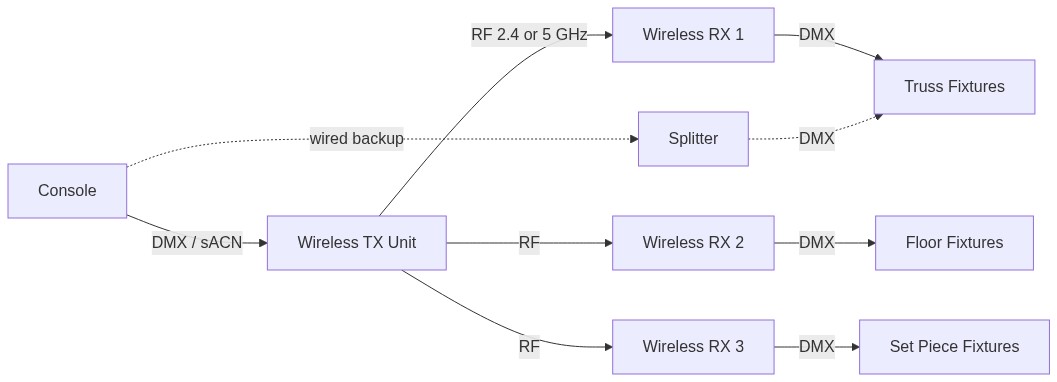
Wireless DMX systems transmit a standard DMX512 universe over a radio frequency (RF) link. A transmitter unit connects to the console DMX output, and one or more receiver units plug into fixtures or dimmer racks. From the console’s perspective, the wireless link is transparent—it sees a normal DMX cable run.
Key performance metrics for wireless DMX:
- Latency: Delay between console output and fixture response. Should be <5 ms for smooth operation; sub-millisecond systems exist.
- Reliability: Percentage of packets received without error. Entertainment-grade systems target 99.99%+.
- Range: Distance between TX and RX in line-of-sight conditions.
- Interference immunity: Ability to operate in RF-dense environments (conventions, arenas).
Major Wireless DMX Systems
| System | Frequency | Technology | Range (LOS) | RDM Support |
|---|---|---|---|---|
| W-DMX G6 (LumenRadio) | 2.4 & 5 GHz | CRMX frequency-hopping | 300+ m | Yes |
| SHoW DMX (City Theatrical) | 900 MHz | FHSS | 1,000+ m | No |
| Swisson XWD | 2.4 GHz | FHSS + diversity | 300 m | Yes |
| Elation Wireless | 2.4 GHz | FHSS | 200 m | No |
| Wireless Ethernet (Wi-Fi) | 2.4 & 5 GHz | 802.11 (standard Wi-Fi) | 50–150 m | Via RDMnet |
CRMX Technology (LumenRadio)
Cognitive Radio technology, developed by LumenRadio and used in the W-DMX G6 system, is the current gold standard for wireless DMX. Key features:
- Continuously monitors the RF environment and hops away from congested frequencies in real time
- Sub-millisecond latency
- Can co-exist with Wi-Fi and Bluetooth without coordination
- Bidirectional link supports full RDM
- Up to 40 universes on a single CRMX transmitter (with compatible receivers)
Frequency Band Considerations
| Band | Range | Penetration | Congestion | Notes |
|---|---|---|---|---|
| 900 MHz | Longest | Excellent (walls, bodies) | Low | Best for outdoor / obstructed paths; lower data rate |
| 2.4 GHz | Medium | Good | High (Wi-Fi, BT, microwave) | Most common; requires careful channel planning in busy venues |
| 5 GHz | Shortest | Fair | Low–Medium | Faster; preferred in high-density venues (arenas, convention centers) |
Wireless Ethernet for Lighting Control
An alternative to wireless DMX is wireless Ethernet carrying sACN or Art-Net. A standard enterprise Wi-Fi access point bridges the lighting console to remote nodes, delivering multiple universes simultaneously over a single RF link. This approach:
- Scales to hundreds of universes without additional hardware
- Supports console remote panels and tablet control apps
- Requires secure, dedicated Wi-Fi configuration (see Network Systems Equipment)
- Typically has higher latency (5–15 ms) than dedicated wireless DMX
Range Factors and RF Survey
Antenna gain, transmit power, and environment all affect reliable range:
- FCC Part 15 (US): Limits transmit power for unlicensed devices; output power of entertainment wireless DMX is regulated
- Metal structures: Trusses, steel decking, and HVAC equipment reflect and absorb RF
- Human bodies: Crowds attenuate 2.4 GHz significantly; plan for worst-case audience density
- Co-channel interference: Other wireless DMX, Wi-Fi, IEM (in-ear monitor) systems, and two-way radios
Always conduct a pre-show RF survey using a spectrum analyzer. Coordinate frequency assignments with audio, IEM, and video departments. Document channel/frequency selections.
Redundancy and Backup Planning
Wireless systems should never be the sole control path for critical lighting in live productions without a backup plan:
- Pre-run wired DMX to all positions as a backup path
- Test wired backup before going live with wireless
- Some wireless systems (CRMX) offer dual-transmitter redundancy
- Establish a clear procedure for switching from wireless to wired if signal degrades
References
ANSI E1.11. (2008). Entertainment technology: USITT DMX512-A — asynchronous serial digital data transmission standard for controlling lighting equipment and accessories (Rev. 2018). ESTA. Free download: tsp.esta.org
ANSI E1.20. Entertainment technology: Remote device management over USITT DMX512. ESTA. Free download: tsp.esta.org
Entertainment Services and Technology Association. (1996). Recommended practice for Ethernet cabling systems in entertainment lighting applications. ESTA.
Huntington, J. (2000). Control systems for live entertainment (2nd ed.). Focal Press.
Cadena, R. (2006). Automated lighting: The art and science of moving light in theatre, live performance, and entertainment. Focal Press.
See Also: