
Entertainment Distribution Equipment: Dimmer Racks, Relay Racks, PDUs, and Motor Control
Distribution equipment is the layer between the feeder from the service and the individual circuits that supply loads. It routes power, protects circuits, and — in the case of dimmers — controls the output level of each circuit. Selecting and installing distribution equipment correctly determines whether a production’s electrical system is safe, compliant, and reliable. ETCP Domain 1E tests these installation skills directly.
Dimmer Racks
A dimmer rack (also called a dimmer rack system or soft-patch system) controls the intensity of incandescent and tungsten-halogen loads by phase-cutting the AC sine wave using solid-state switching devices. Two technologies are used in modern entertainment dimmers:
- SCR (Silicon Controlled Rectifier) dimmers: The historical standard. SCR dimmers fire on the leading edge of the sine wave, phase-cutting the trailing edge. They produce a characteristic “buzz” in incandescent lamp filaments, audible in quiet theater environments. SCR dimmers should not be used with electronic loads (LED drivers, switching power supplies, motors) because the chopped waveform can damage these devices.
- IGBT (Insulated Gate Bipolar Transistor) dimmers: Modern solid-state switching technology. Can operate in leading-edge, trailing-edge, or sine-wave mode. Sine-wave mode filters the output to a complete sine wave, making IGBT dimmers suitable for LED, electronic, and motor loads when in that mode (Cadena, 2009).
Touring dimmer racks typically contain 48 or 96 independent 2.4 kW (20A at 120V) dimmer modules in a portable case with wheels and handles. Permanent theatrical installations may use rack-mounted modules or dedicated dimmer systems integrated into the building’s electrical infrastructure. Each dimmer module connects to one branch circuit output, which connects to a stage pin outlet, a multi-cable panel, or a direct circuit run to the fixture position.

Relay Racks
Relay racks (also called non-dim racks or relay packs) provide switched — not dimmed — circuit outputs for loads that must not receive a phase-cut waveform. LED fixtures require full-cycle AC power; their internal power supplies handle the conversion. Automation motors and hoist controls require clean AC for variable frequency drives (VFDs). Audio transformers and isolation transformers overheat when fed a chopped waveform.
Relay racks switch each circuit with a contactor — a magnetically latching heavy-duty switch rated for the full motor inrush current, unlike a silicon switch. Contactors can be controlled via DMX, RDM, or a digital control system that receives cues from the lighting console. Most modern relay racks allow individual circuit assignment as “dim” or “relay” from the console patch, providing flexibility when the production’s load mix changes (Cadena, 2009).
Power Distribution Units (PDUs)
A PDU takes a single high-current three-phase feeder input and distributes it through multiple breaker-protected branch circuit outputs, typically without controlling intensity. PDUs are used for audio amplifier racks, video equipment, and other loads that need clean, switched (not dimmed) power. They may include a panel-mounted meter showing input voltage and current per phase, which allows the production electrician to monitor loading balance in real time.
PDUs intended for entertainment use are available in road-case configurations, with single-pole connector inputs and a variety of output connector types. The overcurrent device rating at each output must not exceed the ampacity of the branch circuit conductors it protects (National Fire Protection Association [NFPA], 2023).

Motor Control Centers (MCCs)
Automation systems — hoists, turntables, tracking systems, traps — require dedicated motor control equipment that provides not only power but the control interface for safe motion. A motor control center contains the power disconnects, variable frequency drives (VFDs), and contactors for each motor circuit, plus an emergency stop (e-stop) circuit that opens all motor power in response to a safety trigger. E-stop circuits must use hard-wired safety relays or safety PLCs — a software e-stop command does not meet the requirements of ANSI E1.6-1 for powered hoist systems (ESTA, 2019).
Distribution Tree and Equipment Comparison
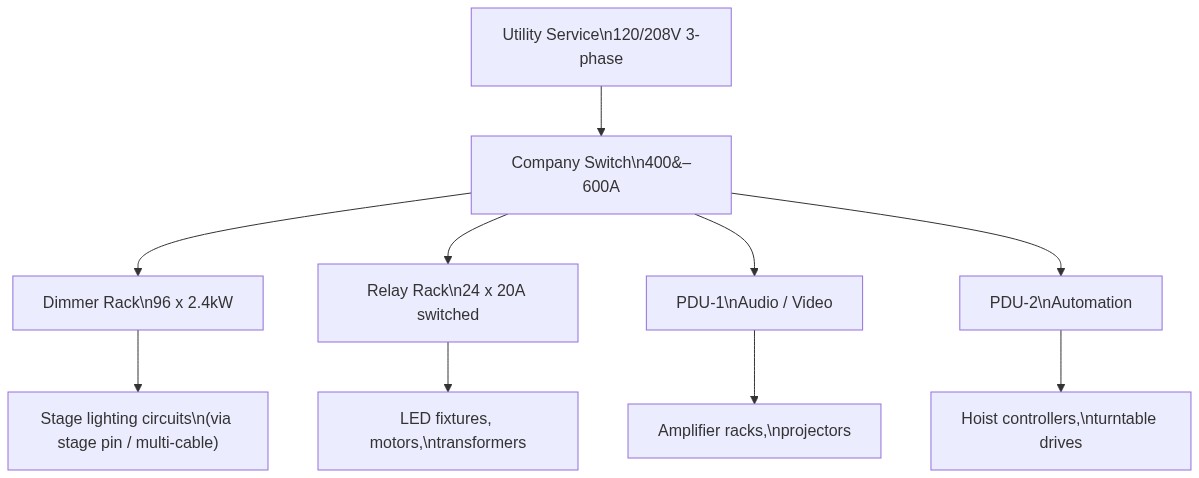
| Equipment | Controls Intensity | Circuit Type | Controlled Via | Typical Input |
|---|---|---|---|---|
| Dimmer rack | Yes (phase-cut) | Dimmed | DMX512 | 3-phase feeder |
| Relay rack | No (on/off only) | Switched | DMX512 / RDM | 3-phase feeder |
| PDU | No | Breaker-protected branch circuits | None (manual breakers) | 3-phase feeder |
| Motor control center | Speed (via VFD) | Motor circuits | DMX / EtherNet/IP | 3-phase feeder |
Installation Requirements
All distribution equipment must be positioned for:
- Ventilation: Dimmer racks and relay racks generate significant heat. Blocking intake or exhaust vents causes thermal shutdown, potentially mid-show. Minimum clearances specified by the manufacturer must be maintained on all sides.
- Stability: Equipment must not tip, roll, or shift under show conditions. Road cases on casters must have locking casters engaged during operation. Equipment in fly positions must be secured with rated rigging hardware and secondary safety cables.
- Grounding: Every metal enclosure — rack frames, cable trays, breakout boxes — must be bonded to the equipment grounding conductor. Ground connections must be verified before energizing (OSHA, 2015).
- Labeling: Circuit labels on output panels must be legible and accurate. Incorrect labeling is a troubleshooting hazard and a code compliance issue under NFPA 70 Article 408 (NFPA, 2023).
- Access: A working clearance of 36 inches in front of any panel with live parts must be maintained per NEC 110.26. Do not stack cases or store equipment in front of open dimmer racks.
References
Cadena, R. (2009). Electricity for the entertainment electrician & technician. Focal Press.
Entertainment Services and Technology Association. (2019). ANSI E1.6-1-2018: Entertainment technology — Powered hoist systems. ESTA.
National Fire Protection Association. (2023). NFPA 70: National Electrical Code. NFPA.
Occupational Safety and Health Administration. (2015). 29 CFR 1910.303: General requirements for electrical installations. U.S. Department of Labor.
See Also:
- Entertainment Distribution Equipment: Dimmer Racks, Relay Racks, PDUs, and Motor Control
- Setting Up Portable Power Distribution Equipment: Dimmer Racks, Relay Racks, PDUs, and Motor Control Centers
- Calculating Weight Distributions of Overhead Electrical Equipment for Entertainment Rigging
- ETCP Electrician Exam 1D: Setting Up Entertainment Lighting Control Systems