
Codes and Standards for Overhead Rigging in Entertainment: ANSI E1.6-1, OSHA, and Venue Requirements
Hanging overhead electrical equipment in entertainment is governed by a layered set of standards and codes. Federal OSHA regulations set the floor; ANSI/ESTA entertainment-specific standards go further for powered rigging systems; and the Authority Having Jurisdiction (AHJ) — the local building department, fire marshal, or venue — may impose additional requirements. Skilled electricians must know knowledge of which standards apply to which situations and what they require.
ANSI E1.6-1: Powered Entertainment Hoist Systems
ANSI E1.6-1 (ESTA, 2019) is the primary entertainment-specific standard for electric chain hoists and motor-driven lifting systems used to raise and lower loads over performance spaces. It applies whenever a powered hoist system is used in an entertainment context — touring concerts, permanent theatrical installations, and temporary event structures all fall within scope.
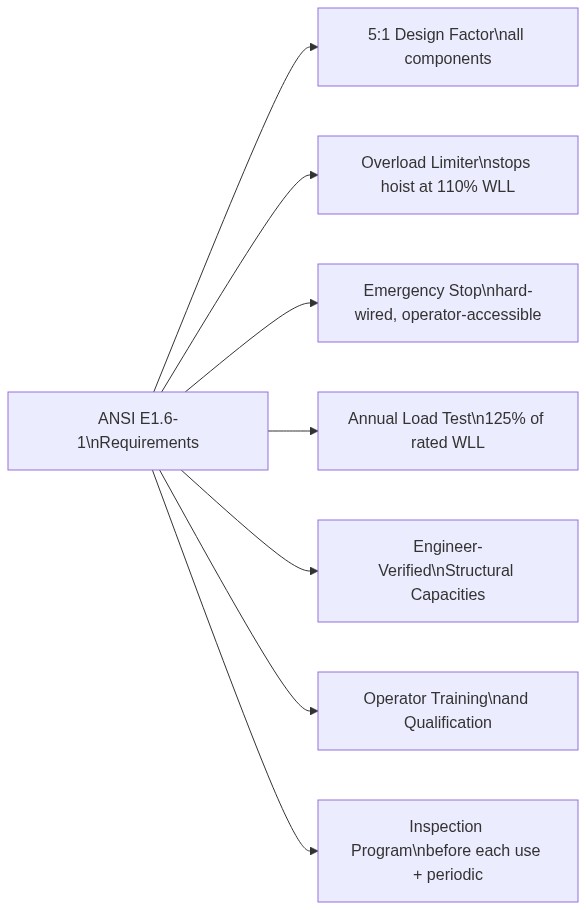
Key E1.6-1 requirements:
- 5:1 design factor: Every component in the hoist system — hoist, hook, shackle, structural attachment — must have a minimum 5:1 ratio of ultimate strength to WLL.
- Overload limiting device: The hoist must have a device that prevents it from lifting a load exceeding 110% of its rated WLL. This protects against inadvertent overloading when a jammed or snagged load is not visible to the operator.
- Emergency stop: A hard-wired e-stop must be accessible to the operator and must remove power from all hoists in the system. Software-only e-stop commands do not satisfy this requirement.
- Annual load test: Powered entertainment hoist systems must be tested at 125% of rated WLL at least annually, with results documented.
- Structural engineering: The building structure used to support the hoist system must be reviewed and approved by a licensed structural engineer before use.
- Operator training: Persons operating powered entertainment hoist systems must be trained and qualified per E1.6-1 requirements (ESTA, 2019).
ANSI E1.6-2: Manual Counterweight Fly Systems
ANSI E1.6-2 covers the design, installation, operation, and maintenance of manually operated counterweight fly systems in theatrical venues. Key requirements include documented line set ratings, balance procedures, loading bridge requirements, and locking off unattended line sets. Entertainment electricians in theatrical venues must understand these requirements because they routinely interact with the fly system when loading electrical equipment onto battens.
OSHA 29 CFR 1910.184: Slings
OSHA 1910.184 governs the use, inspection, and removal from service of rigging slings in general industry, which includes entertainment. It establishes:
- Slings must be removed from service when they show broken wires, kinks, corrosion, heat damage, or end fitting damage
- Alloy chain slings must not be used with hooks, rings, or attachments that have a lower rating than the chain itself
- Sling angles must be controlled — the standard does not impose a hard angle limit but requires that the rated capacity be calculated for the actual angle used
- Synthetic slings (roundslings) must be removed when they show cuts, tears, discoloration, or UV damage (OSHA, 2015)
ASME B30 Standards
The American Society of Mechanical Engineers (ASME) B30 series covers lifting devices, hardware, and accessories. The series most relevant to entertainment electricians:
- B30.9 Slings: Covers sling ratings, inspection criteria, and use procedures for wire rope, chain, metal mesh, and synthetic slings. More detailed than OSHA 1910.184 in some areas.
- B30.10 Hooks: Covers hook types (shank hooks, eye hooks, clevis hooks), safety latch requirements, load ratings, inspection, and use.
- B30.16 Overhead Underhung Hoists: Covers electric and manual chain hoists used overhead, complementing ANSI E1.6 in general industrial applications.
Authority Having Jurisdiction (AHJ)
The AHJ is whoever has legal authority over the installation or event — typically the local building department, fire marshal, or a designated venue rigging authority. AHJ requirements vary widely by jurisdiction. Some cities require a licensed rigger (separate from ETCP certification) for all entertainment rigging; some require a permit; some require an engineer-stamped rigging plan. Before rigging in an unfamiliar venue, contact the venue operations staff to determine what local authority requirements apply (ESTA, 2019).
ETCP certification is widely recognized by AHJs as evidence of competency, but it does not replace jurisdiction-specific licensing requirements where those exist.
Standards Reference
Occupational Safety and Health Administration. (n.d.). 29 CFR 1910 subpart S: Electrical. U.S. Department of Labor.
Earley, M. W., Sargent, J. S., Sheehan, J. V., & Buss, E. W. (2008). National Electrical Code handbook (11th ed.). National Fire Protection Association.
Jones, R. A., Mastrullo, K. G., & Jones, J. G. (2004). NFPA 70E handbook for electrical safety in the workplace. National Fire Protection Association.
Box, H. C. (2010). Set lighting technician’s handbook: Film lighting equipment, practice, and electrical distribution (4th ed.). Focal Press.
Underwriters Laboratories. (2000). Standard for safety for portable power-distribution equipment (2nd ed.). UL.
Hart, G. V., & Hart, S. (2008). Ugly’s electrical references. Burleson Distributing Corp.
References
Occupational Safety and Health Administration. (n.d.). 29 CFR 1910 subpart S: Electrical. U.S. Department of Labor.
Earley, M. W., Sargent, J. S., Sheehan, J. V., & Buss, E. W. (2008). National Electrical Code handbook (11th ed.). National Fire Protection Association.
Jones, R. A., Mastrullo, K. G., & Jones, J. G. (2004). NFPA 70E handbook for electrical safety in the workplace. National Fire Protection Association.
Box, H. C. (2010). Set lighting technician’s handbook: Film lighting equipment, practice, and electrical distribution (4th ed.). Focal Press.
Underwriters Laboratories. (2000). Standard for safety for portable power-distribution equipment (2nd ed.). UL.
Hart, G. V., & Hart, S. (2008). Ugly’s electrical references. Burleson Distributing Corp.
See Also:
- An overview of OSHA 1926.502: Fall Protection Standards and The Application in the Theater and Entertainment Industry
- Calculating Weight Distributions of Overhead Electrical Equipment for Entertainment Rigging
- Chain Hoists and Mechanical Advantage Systems for Entertainment Overhead Rigging
- Electrical Safety in Performing Arts: The NEC, OSHA Standards, and Theater-Specific Code Requirements