
Chain Hoists and Mechanical Advantage Systems for Entertainment Overhead Rigging
Chain hoists and manual mechanical advantage systems are the primary tools for raising and lowering overhead electrical equipment. Understanding how they work — their ratings, limitations, operational requirements, and safety features — is essential for any entertainment electrician who works in the overhead environment. Domain 1B covers both the technical knowledge of hoist types and the practical safety requirements for their use.
Electric Chain Hoists
An electric chain hoist consists of an electric motor driving a geared transmission that pulls or pays out a load chain. The upper hook attaches to a structural anchor (beam clamp, structural attachment point); the hook block travels on the load chain to raise and lower the attached load. The chain is collected in a chain bag as it feeds off the load sprocket when the hook block descends.
Motor and braking: The motor runs in forward (lift) or reverse (lower) as commanded. A mechanical brake holds the load when power is removed — this is a critical safety feature. In standard entertainment chain hoists, the brake is spring-applied and motor-released: when the motor de-energizes, the spring clamps the brake disc, preventing the load from descending. This means a power failure leaves the load held in position (ANSI E1.6-1, 2022).
Chain: Entertainment chain hoists use load chain specifically manufactured to match the hoist. Do NOT substitute a different chain in a chain hoist — the tooth profile of the hoist’s load sprocket is matched to the chain geometry, and an incorrect chain can jump teeth or jam, causing sudden load drop. Entertainment chain is Grade 80 or Grade 100 alloy steel.
Overload protection: ANSI E1.6-1 requires that powered entertainment hoists include an overload limiting device that stops the hoist when the load exceeds 110% of the rated WLL. This protects against inadvertent overloading due to snagged equipment, jammed chain, or miscounted loads (ESTA, 2019).
D/d ratio: When chain wraps around the load sprocket, the chain links must bend. The ratio of the sprocket pitch diameter (D) to the chain wire diameter (d) determines the bending stress. Hoists are designed with a D/d ratio that maintains acceptable chain fatigue life. Never substitute chain that is undersized for the sprocket — a smaller wire diameter increases bending stress and shortens chain life dramatically.
Variable Speed and Motor Automation
Variable speed electric chain hoists use variable frequency drives (VFDs) to control motor speed, enabling the hoist to travel at any speed from zero to maximum. This is essential for motor automation systems where multiple hoists must move in coordination — a truss rising evenly, scenery tracking precisely, or a performer lift requiring controlled acceleration and deceleration profiles.
Variable speed hoists used in automation systems typically include position feedback (incremental encoders or absolute encoders on the chain sprocket) that allows the hoist controller to track position and enforce limits. Soft limits stop the hoist before it reaches a hard mechanical stop; hard limits (limit switches) cut motor power if the soft limits are overrun (ESTA, 2019).
Manual Chain Blocks
A manual chain block (hand chain hoist) uses a hand-operated chain wheel to operate the same internal gear-and-brake mechanism as an electric chain hoist. The operator pulls the hand chain to lift or lower the load. A load-holding brake automatically engages when the hand chain is released, holding the load in position.
Manual blocks provide significant mechanical advantage — a 1/2-ton (1,000 lb) manual block typically requires only 30–40 lb of pull force on the hand chain to raise the rated load. This mechanical advantage is created by the gear ratio inside the block. The tradeoff is travel speed: many hand-chain pulls are needed to raise the load a short distance.
Manual chain blocks are widely used in entertainment rigging for static hanging applications — raising a truss to trim height from a temporary bridle, adjusting the height of a speaker hang — where electric hoists are not installed or not warranted. Once at trim, the load is typically transferred to fixed rigging hardware; the manual block is not intended to be left in service as a permanent support (ANSI E1.6-1, 2022).
Lever Hoists (Come-Alongs)
A lever hoist uses a ratchet mechanism driven by a lever handle. Each pump of the lever advances the load chain a few millimeters. Lever hoists are rated for tensioning and pulling, and while they can be used for lifting in controlled conditions, they are primarily used in rigging applications for:
- Adjusting bridle geometry by tensioning individual legs
- Pulling and tensioning wire rope or cable runs
- Short-travel positioning of heavy equipment on the ground
Lever hoists have no motorized brake — the load is held by the ratchet when the lever is at rest. Most lever hoists have a “neutral” position that releases the ratchet for free-wheel lowering; this position must never be engaged while a load is suspended without the operator maintaining control of the lever.
Mechanical Advantage: Block-and-Tackle Basics
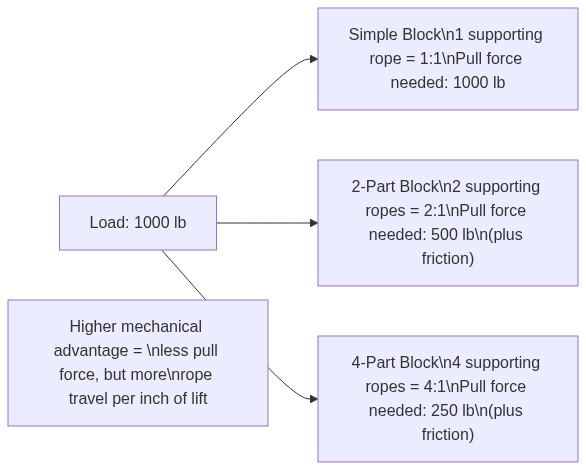
The fundamental principle of mechanical advantage: the number of rope parts supporting the load determines the mechanical advantage. A two-part block has two ropes pulling up on the load block — each rope carries half the load, so the operator only needs to exert half the load force. However, for every foot the load rises, two feet of rope must be pulled through. Friction in the blocks increases the required force beyond the theoretical calculation (ANSI E1.6-1, 2022).
Hoist Comparison Reference
Occupational Safety and Health Administration. (n.d.). 29 CFR 1910 subpart S: Electrical. U.S. Department of Labor.
Earley, M. W., Sargent, J. S., Sheehan, J. V., & Buss, E. W. (2008). National Electrical Code handbook (11th ed.). National Fire Protection Association.
Jones, R. A., Mastrullo, K. G., & Jones, J. G. (2004). NFPA 70E handbook for electrical safety in the workplace. National Fire Protection Association.
Box, H. C. (2010). Set lighting technician’s handbook: Film lighting equipment, practice, and electrical distribution (4th ed.). Focal Press.
Underwriters Laboratories. (2000). Standard for safety for portable power-distribution equipment (2nd ed.). UL.
Hart, G. V., & Hart, S. (2008). Ugly’s electrical references. Burleson Distributing Corp.
References
Occupational Safety and Health Administration. (n.d.). 29 CFR 1910 subpart S: Electrical. U.S. Department of Labor.
Earley, M. W., Sargent, J. S., Sheehan, J. V., & Buss, E. W. (2008). National Electrical Code handbook (11th ed.). National Fire Protection Association.
Jones, R. A., Mastrullo, K. G., & Jones, J. G. (2004). NFPA 70E handbook for electrical safety in the workplace. National Fire Protection Association.
Box, H. C. (2010). Set lighting technician’s handbook: Film lighting equipment, practice, and electrical distribution (4th ed.). Focal Press.
Underwriters Laboratories. (2000). Standard for safety for portable power-distribution equipment (2nd ed.). UL.
Hart, G. V., & Hart, S. (2008). Ugly’s electrical references. Burleson Distributing Corp.
See Also:
- Calculating Weight Distributions of Overhead Electrical Equipment for Entertainment Rigging
- Codes and Standards for Overhead Rigging in Entertainment: ANSI E1.6-1, OSHA, and Venue Requirements
- Equipment Hanging Techniques for Entertainment Rigging: Clamps, Motors, Trusses, and Counterweight Systems
- Rigging Hardware Inspection for Entertainment: Chain, Wire Rope, Shackles, and Roundslings