
Equipment Hanging Techniques for Entertainment Rigging: Clamps, Motors, Trusses, and Counterweight Systems
Hanging overhead electrical equipment safely requires selecting and applying the right technique for the structure, the load, and the production. No single method is appropriate for every situation: a C-clamp on a fixed batten works for a small theatrical installation but is wrong for a temporary truss hang requiring adjustable trim height. Skilled electricians must know familiarity with each hanging technique, its limitations, and the safety systems that must accompany it.
C-Clamps (Pipe Clamps)
The C-clamp — also called a pipe clamp or lighting clamp — is the most fundamental fixture hanging device in theatrical lighting. It consists of a threaded bolt passing through a cast-iron or steel body, with a yoke that closes around the pipe or batten. Tightening the bolt clamps the yoke against the pipe. A set screw (sometimes called a safety screw) passes through the yoke perpendicular to the pipe, bearing against the pipe surface to prevent the clamp from twisting or sliding if the main bolt loosens.
Both fasteners — the main bolt and the set screw — must be fully tightened before the fixture is considered secure. C-clamps have individual weight ratings stamped or labeled on the body; most theatrical C-clamps are rated at 50–100 lb. Exceeding the rated capacity or hanging a clamp on an out-of-round or damaged pipe risks failure (ANSI E1.6-1, 2022).
Every fixture hung with a C-clamp requires a safety cable: a rated wire rope or steel chain that attaches from the fixture’s safety attachment point to the pipe or batten, providing a secondary retention path if the clamp fails or the fixture mounting bolt breaks. The safety cable must be of sufficient length to catch the fixture without allowing it to fall more than a few inches.
Beam Clamps
Beam clamps attach to the flange of an I-beam, H-beam, or wide-flange structural member. A threaded bolt bears against the underside of the beam flange while the clamp body hooks over the top. Beam clamps must be selected to match the specific flange width and thickness of the beam — a clamp designed for a 4-inch flange cannot develop its rated load on a 2-inch flange. The rated WLL of the beam clamp must not be exceeded, and the beam itself must be verified by the venue or a structural engineer as capable of supporting the applied load at that point.
Electric Chain Hoists (Chain Motors)
Electric chain hoists (often called “chain motors”) are the standard lifting device for concert touring and large entertainment productions. They consist of an electric motor, a load chain, an upper hook for structural attachment, and a lower hook for the load. They are controlled by a hoist controller and can be operated individually or in coordinated groups by a motor automation system.
Chain hoist sizes in entertainment range from 1/4-ton (500 lb) to 2-ton (4,000 lb) and larger. The size refers to the rated Working Load Limit (WLL). Chain hoists used for entertainment must comply with ANSI E1.6-1 when used as part of a powered hoist system (see Article 5 for details). Dynamic load factors, over-speed protection, and e-stop capability are all ANSI E1.6-1 requirements (ESTA, 2019).
Manual Chain Blocks and Lever Hoists
Manual chain blocks use a hand-operated chainfall to lift loads mechanically. They provide a high mechanical advantage — a 1/2-ton block typically requires about 30–40 lb of pull force to raise a 1,000 lb load — making them effective for trim adjustment and static hanging. Unlike electric chain hoists, manual blocks have no motor or control system, so loads must be secured by the block’s built-in load brake before any work is done below.
Lever hoists (come-alongs) use a ratchet mechanism with a lever handle and are typically used for tensioning, not lifting. They are useful for adjusting bridle geometry and maintaining tension in cable runs.
Wire Rope Bridles
A bridle is a rigging assembly that distributes a load to two or more structural attachment points. Wire rope bridles consist of wire rope, hardware (shackles, swivels), and a connection to the load. The sling angle — the angle between the wire rope leg and the vertical — is critical: as the angle increases from vertical, the tension in each leg increases because each leg must support a larger horizontal component. At 60 degrees from vertical, each leg carries 100% of the total load (not 50%). At 45 degrees, each leg carries 70.7%. Working load limits must be derated for sling angle (OSHA, 2015).
Counterweight Fly Systems
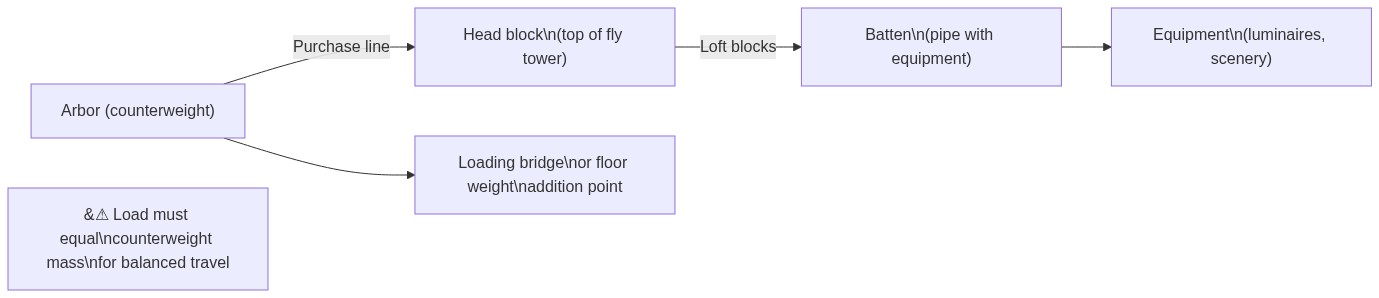
Theater fly houses use counterweight systems to move battens and their loads vertically. Ropes or cables (purchase lines) connect the batten to an arbor loaded with steel counterweights. The arbor weight is adjusted to approximately equal the batten load — when balanced, the batten can be moved with minimal force. Electrical equipment is loaded before counterweights are added, and the arbor is loaded to match. An unbalanced line set — batten load heavier or lighter than the arbor — requires more force to fly and can be dangerous if the pin rail lock is released unexpectedly (ANSI E1.6-1, 2022).
Vertical Mast Lifts
Personnel and material lifts on vertical masts provide height access without a fly system. Mast-based lifts (motor lifts, telescoping towers) must be operated on level surfaces with outriggers fully deployed per manufacturer specifications. Wind loading limits apply to all aerial lifts; operation in winds exceeding the manufacturer’s rating is prohibited. Electrical equipment mounted on mast lifts must be secured against movement during lift travel.
Hanging Technique Comparison
| Technique | Primary Use | Max Load Typical | Key Safety Requirement |
|---|---|---|---|
| C-clamp (pipe clamp) | Fixed pipe or batten | 50–100 lb | Safety cable required; tighten bolt + set screw |
| Beam clamp | I-beam or H-beam flange | Per rated WLL | Must match beam flange width; nut locked |
| Chain motor (electric hoist) | Truss, large loads | 250 lb – 2 ton+ | ANSI E1.6-1; dynamic factor; e-stop required |
| Manual chain block | Static hang, trim adjustment | Per rated WLL | Load must be secured before personnel work below |
| Wire rope (bridle) | Structural point to load | Per WLL & sling angle | Maximum 60° sling angle from vertical |
| Counterweight system | Theatrical fly house | Per line set rating | Balance before travel; lock when unattended |
| Lift (vertical mast) | Ground-supported overhead | Per manufacturer | Level ground; outriggers deployed; wind limits |
| Span set (roundsling) | Truss pickup, structural wrap | Per WLL & angle | Choke reduces WLL 25%; double-wrap choke 10% |
References
Occupational Safety and Health Administration. (n.d.). 29 CFR 1910 subpart S: Electrical. U.S. Department of Labor.
Earley, M. W., Sargent, J. S., Sheehan, J. V., & Buss, E. W. (2008). National Electrical Code handbook (11th ed.). National Fire Protection Association.
Jones, R. A., Mastrullo, K. G., & Jones, J. G. (2004). NFPA 70E handbook for electrical safety in the workplace. National Fire Protection Association.
Box, H. C. (2010). Set lighting technician’s handbook: Film lighting equipment, practice, and electrical distribution (4th ed.). Focal Press.
Underwriters Laboratories. (2000). Standard for safety for portable power-distribution equipment (2nd ed.). UL.
Hart, G. V., & Hart, S. (2008). Ugly’s electrical references. Burleson Distributing Corp.
See Also:
- Calculating Weight Distributions of Overhead Electrical Equipment for Entertainment Rigging
- Chain Hoists and Mechanical Advantage Systems for Entertainment Overhead Rigging
- ETCP Electrician Exam 1B: Hanging and Rigging Overhead Electrical Equipment
- Entertainment Utilization Equipment: Luminaires, Video, Audio, Automation, Effects, and Network Systems