
Rigging Hardware Inspection for Entertainment: Chain, Wire Rope, Shackles, and Roundslings
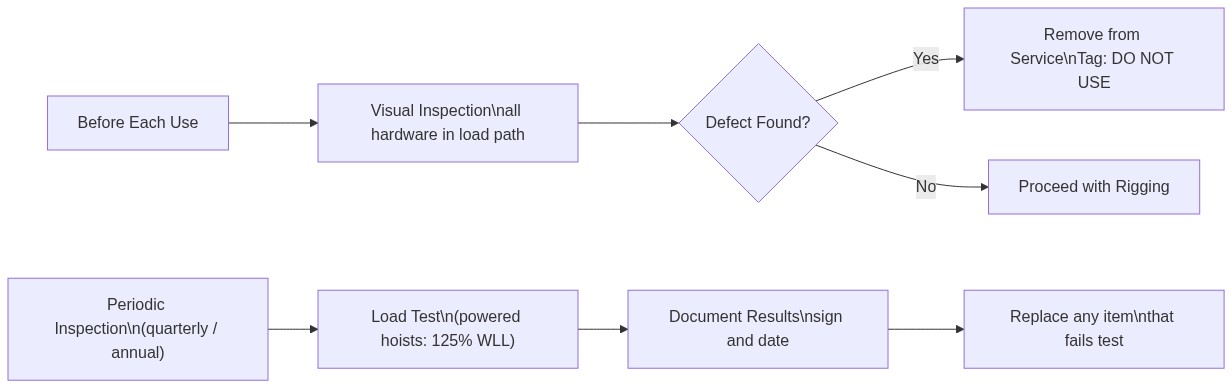
Rigging hardware that has been inspected and accepted is rigging hardware that has been confirmed safe for use. Hardware that has not been inspected — or that shows a defect — must not be put into service overhead regardless of how new it looks, how trusted its source, or how urgent the load-in schedule. Pre-use inspection of all rigging hardware in the load path is a fundamental professional requirement and an important skill in Domain 1B.
The Purpose of Inspection
Rigging hardware is designed with substantial safety factors against rated load under ideal conditions. Real-world use degrades hardware from that ideal: shock loading yields metal; corrosion pits the surface and concentrates stress at the pit; heat alters the metallurgy of alloy chain; UV radiation degrades synthetic slings. An inspection is the process of identifying degradation that has brought the hardware close to, or below, a margin where it can be trusted.
Hardware that passes inspection at one use may fail at the next. Rigging hardware must be inspected before every lift — not just when it looks questionable (OSHA, 2015).
Alloy Chain Inspection
Grade 80 and Grade 100 alloy chain are the standard materials for entertainment lifting chain. “Grade” refers to the chain’s proof load expressed as the chain wire diameter squared times the grade number. Grade 80 is the minimum accepted grade for overhead lifting in entertainment; Grade 30 (common galvanized hardware chain) and Grade 43 (high-test chain) are NOT rated for overhead lifting and must never be used in a rigging load path (ASME, 2021).
Inspect each link individually:
- Run the chain through gloved hands, feeling for resistance that indicates a deformed link
- Visually check each link for nicks, cracks, gouges, and corrosion
- Measure link diameter with calipers — wear exceeding 10% of the original wire diameter is grounds for removal
- Check chain length against a known reference — elongation beyond 3% of original length indicates the chain has been loaded beyond its proof load
- Verify grade stamps on every 10th link or less — if stamps are absent, the grade cannot be verified and the chain must not be used for overhead lifting
Chain that has been exposed to acids, exposed to heat above 400°F, or shock-loaded to the point of visible deformation must be permanently retired (OSHA, 2015).
Wire Rope Inspection
Wire rope is inspected by running a rag slowly along the full length while watching for the rag to catch on broken wires. The standard discard criteria under OSHA 1910.184 and ASME B30.9:
- Six or more broken wires in one rope lay (the distance for one strand to make one complete revolution around the rope core)
- Three or more broken wires in one strand within one rope lay
- Visible corrosion on the outer strands or inside the rope (if separated at a bend)
- Kinking, crushing, or birdcaging — any geometric deformation of the rope cross-section
- Evidence of heat damage: discoloration, melting of lubricant, or fusion of strands
- Reduction in diameter exceeding one-third of the original diameter (OSHA, 2015)
Shackle Inspection
Inspect shackles for: cracks (use a flashlight and magnifier if necessary); elongation of the pin hole or bow opening; pin thread condition (full thread engagement is required); correct pin size (a shackle must not be assembled with a pin smaller than its design specifies); and evidence of distortion from shock loading (the bow will widen or elongate if overloaded). The safety pin locking wire or cotter pin must be present and intact (ASME, 2021).
Screw pin shackles used in overhead applications must have the pin secured against unscrewing. In rotating loads or vibrating environments, the pin can back out over time, losing the bow connection entirely. The standard practice is to “mouse” the pin by passing a length of stainless wire through the pin shackle hole and wrapping it around the shackle bow.
Roundsling (Span Set) Inspection
Roundslings are constructed of load-bearing polyester fibers encased in a tubular woven jacket. The inner fibers cannot be inspected directly — the jacket protects them from damage but also conceals damage when it occurs. Reject any roundsling with: cuts or tears in the jacket; exposed inner fibers (the white or color-bearing load-bearing core showing through the outer jacket); charring, melting, or any thermal damage; chemical discoloration or contamination; missing or illegible ID tag (the rated capacity cannot be verified without the tag) (OSHA, 2015).
Rejection Criteria Reference
Occupational Safety and Health Administration. (n.d.). 29 CFR 1910 subpart S: Electrical. U.S. Department of Labor.
Earley, M. W., Sargent, J. S., Sheehan, J. V., & Buss, E. W. (2008). National Electrical Code handbook (11th ed.). National Fire Protection Association.
Jones, R. A., Mastrullo, K. G., & Jones, J. G. (2004). NFPA 70E handbook for electrical safety in the workplace. National Fire Protection Association.
Box, H. C. (2010). Set lighting technician’s handbook: Film lighting equipment, practice, and electrical distribution (4th ed.). Focal Press.
Underwriters Laboratories. (2000). Standard for safety for portable power-distribution equipment (2nd ed.). UL.
Hart, G. V., & Hart, S. (2008). Ugly’s electrical references. Burleson Distributing Corp.
Documentation and Traceability
Professional rigging practice and many venue requirements specify that rigging hardware be uniquely identified (tagged or serial-numbered) and that inspection records be maintained. For powered entertainment hoist systems under ANSI E1.6-1, documented inspection records are required. A chain or hoist that cannot be traced to its last inspection and load test result should be treated as uninspected and removed from service until it can be documented (ESTA, 2019).
References
Occupational Safety and Health Administration. (n.d.). 29 CFR 1910 subpart S: Electrical. U.S. Department of Labor.
Earley, M. W., Sargent, J. S., Sheehan, J. V., & Buss, E. W. (2008). National Electrical Code handbook (11th ed.). National Fire Protection Association.
Jones, R. A., Mastrullo, K. G., & Jones, J. G. (2004). NFPA 70E handbook for electrical safety in the workplace. National Fire Protection Association.
Box, H. C. (2010). Set lighting technician’s handbook: Film lighting equipment, practice, and electrical distribution (4th ed.). Focal Press.
Underwriters Laboratories. (2000). Standard for safety for portable power-distribution equipment (2nd ed.). UL.
Hart, G. V., & Hart, S. (2008). Ugly’s electrical references. Burleson Distributing Corp.
See Also:
- Chain Hoists and Mechanical Advantage Systems for Entertainment Overhead Rigging
- Chain in Theatrical Rigging: Grades, Working Load Limits, Hoist Safety, and Inspection Requirements
- Calculating Weight Distributions of Overhead Electrical Equipment for Entertainment Rigging
- Codes and Standards for Overhead Rigging in Entertainment: ANSI E1.6-1, OSHA, and Venue Requirements