
Calculating Weight Distributions of Overhead Electrical Equipment for Entertainment Rigging
Before anything goes in the air, an entertainment electrician must calculate how much it weighs and where that weight falls on the structure supporting it. Weight distribution determines whether a batten, truss, or structural attachment point is within its rated capacity. Domain 1B covers this calculation skill directly — including the ability to account for cable weight, concentrated fixture loads, uniformly distributed loads, and the dynamic effects of moving equipment.
Why Weight Distribution Matters
A truss or batten that is overloaded does not always fail gradually. Structural members under compression can experience sudden buckling; rigging hardware under tension can fail without visible warning. The consequences of an overhead load failure in entertainment — where personnel and audiences work directly below flown equipment — are potentially catastrophic. Calculating weight distribution before load-in is not an optional best practice; for permanent installations it is a code requirement under NFPA 70, and for powered hoists it is required by ANSI E1.6-1 (Entertainment Services and Technology Association [ESTA], 2019).
Types of Loads
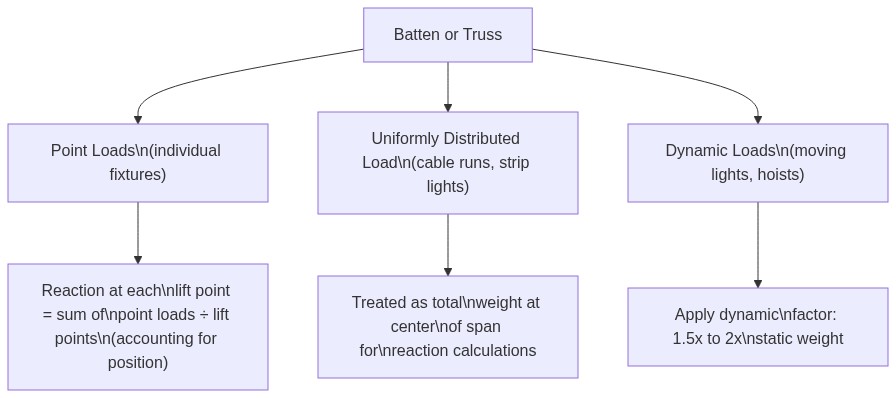
Point loads are concentrated weights at specific positions — individual luminaires, projectors, or video panels. A point load creates a reaction at the support points whose magnitude depends on the load’s position relative to those supports.
Uniformly distributed loads (UDL) spread weight evenly over a length — cable bundles running the full length of a batten, strip lights, LED tape runs. For reaction calculations, a UDL is treated as its total weight acting at the midpoint of the span.
Dynamic loads arise from moving mass. A large moving light tracking rapidly across its pan range exerts forces beyond its static weight due to acceleration and deceleration. A chain hoist lifting a load from rest applies a jerk load at the start of travel. ANSI E1.6-1 requires that dynamic loading be considered in powered hoist system design, typically by applying a dynamic factor of 1.5x to 2x the static load (ESTA, 2019).
Calculating Reactions at Support Points
For a simple beam (batten or truss span) supported at two points A and B with a point load P at distance a from support A and b from support B (where a + b = L, the total span):
- Reaction at A = P × b ÷ L
- Reaction at B = P × a ÷ L
Example: A 40-lb (18 kg) projector is hung 10 feet from one end of a 30-foot batten. Lift points are at each end.
- Reaction at near end = 40 × 20 ÷ 30 = 26.7 lb
- Reaction at far end = 40 × 10 ÷ 30 = 13.3 lb
Sum: 26.7 + 13.3 = 40 lb. The check is always that reactions sum to the total load (ANSI E1.6-1, 2022).
For multiple point loads, calculate each load’s contribution to each support reaction independently, then sum. For a UDL of total weight W across the full span, each support carries W/2.
Cable Weight: The Often-Forgotten Load
Cable weight is systematically underestimated. A lighting batten with 12 luminaires, each fed by 50 feet of 12 AWG stage pin cable (approximately 9.5 lb per 100 feet), carries a cable weight of roughly 12 × 0.5 × 9.5 = 57 lb from cable alone — comparable to the fixtures themselves for an incandescent rig. Multi-cable adds more: a 50-foot 19-pin Socapex assembly weighs approximately 15–20 lb. The cable load must be added to fixture weight before comparing the total to the batten’s rated capacity (ANSI E1.6-1, 2022).
Equipment Weight Reference
Occupational Safety and Health Administration. (n.d.). 29 CFR 1910 subpart S: Electrical. U.S. Department of Labor.
Earley, M. W., Sargent, J. S., Sheehan, J. V., & Buss, E. W. (2008). National Electrical Code handbook (11th ed.). National Fire Protection Association.
Jones, R. A., Mastrullo, K. G., & Jones, J. G. (2004). NFPA 70E handbook for electrical safety in the workplace. National Fire Protection Association.
Box, H. C. (2010). Set lighting technician’s handbook: Film lighting equipment, practice, and electrical distribution (4th ed.). Focal Press.
Underwriters Laboratories. (2000). Standard for safety for portable power-distribution equipment (2nd ed.). UL.
Hart, G. V., & Hart, S. (2008). Ugly’s electrical references. Burleson Distributing Corp.
Comparing to Rated Capacity
Once the total load at each support point is calculated, it must be compared to:
- The rated capacity of the hoist, motor, or lifting device at that point
- The rated capacity of the structural attachment (beam clamp, eye bolt, etc.)
- The rated capacity of the batten or truss itself (uniformly distributed and point load limits are both rated separately)
- The rated capacity of the building structure at the attachment point (provided by a structural engineer or the venue’s rigging plot)
If any element in the load path is exceeded, the load must be reduced, redistributed, or the equipment must be ground-supported. The limiting element in the system — the one with the lowest capacity — determines the system’s working load limit (Occupational Safety and Health Administration [OSHA], 2015).
References
Occupational Safety and Health Administration. (n.d.). 29 CFR 1910 subpart S: Electrical. U.S. Department of Labor.
Earley, M. W., Sargent, J. S., Sheehan, J. V., & Buss, E. W. (2008). National Electrical Code handbook (11th ed.). National Fire Protection Association.
Jones, R. A., Mastrullo, K. G., & Jones, J. G. (2004). NFPA 70E handbook for electrical safety in the workplace. National Fire Protection Association.
Box, H. C. (2010). Set lighting technician’s handbook: Film lighting equipment, practice, and electrical distribution (4th ed.). Focal Press.
Underwriters Laboratories. (2000). Standard for safety for portable power-distribution equipment (2nd ed.). UL.
Hart, G. V., & Hart, S. (2008). Ugly’s electrical references. Burleson Distributing Corp.
See Also:
- ETCP Electrician Exam 1B: Hanging and Rigging Overhead Electrical Equipment
- Chain Hoists and Mechanical Advantage Systems for Entertainment Overhead Rigging
- Codes and Standards for Overhead Rigging in Entertainment: ANSI E1.6-1, OSHA, and Venue Requirements
- ETCP Electrician Exam 1E: Assembling and Installing Entertainment Electrical Equipment