
DMX512/RDM Distribution Systems — ETCP Domain 1D
DMX512 is the universal language of entertainment lighting control. Understanding its physical layer specification, distribution requirements, and the RDM extension is fundamental to real-world system design.
DMX512-A Technical Specification
DMX512-A (ANSI E1.11-2008) defines a unidirectional, asynchronous serial protocol for controlling lighting equipment:
| Parameter | Specification |
|---|---|
| Physical layer | EIA-485 (RS-485) balanced differential pair |
| Transmission speed | 250 kbps |
| Channels per universe | 512 (slots) |
| Cable impedance | 120 Ω characteristic impedance |
| Standard connector | 5-pin XLR (pins 1=shield, 2=data−, 3=data+) |
| Maximum devices per run | 32 unit loads (practical limit) |
| Maximum cable run | 300 m (1,000 ft) recommended |
| Packet rate | Up to 44 packets/second |
Cable specification: Always use true DMX cable with 120 Ω characteristic impedance. Microphone cable (typically 75 Ω) will work over short distances but causes reflections and signal errors on longer runs. Shielded twisted pair is required; the shield connects to pin 1 at one end only (to prevent ground loops).
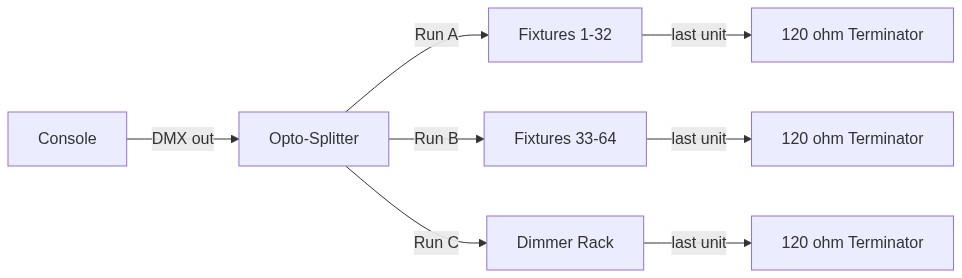
Opto-Splitters (Opto-Isolators)
An opto-splitter receives one DMX input and provides multiple optically isolated outputs. Optical isolation breaks the electrical connection between the source and the load, preventing ground loops that can inject noise into the control signal.
Key benefits:
- Regenerates the DMX signal (restores rise time, amplitude, and timing)
- Allows multiple independent cable runs from one universe output
- Each output can drive up to 32 unit loads / 300 m
- Eliminates ground-loop interference between console and fixtures
Common opto-splitter configurations: 1-in/2-out, 1-in/4-out, 1-in/8-out. Leading manufacturers: Doug Fleenor Design, Pathway Connectivity, Elation, Enttec, City Theatrical.
DMX Mergers
A merger combines two DMX sources into a single output. The merge mode determines how conflicting values from the two sources are resolved:
| Merge Mode | Algorithm | Best Use Case |
|---|---|---|
| HTP (Highest Takes Precedence) | Output = MAX(source A, source B) per channel | Dimmer stacks, safety override (emergency lighting) |
| LTP (Latest Takes Precedence) | Output = whichever source most recently sent a non-zero value | Moving lights, color changers (prevents fighting between consoles) |
| Override / Takeover | Source B overrides A completely when active | Backup console takeover on operator command |
Practical merger applications: backup console systems, emergency lighting overrides, multi-operator productions (FOH lighting + floor FX simultaneously).
Termination — The Most Commonly Missed Step
A 120 Ω terminator must be connected to the DMX output of the last device on every run. Termination absorbs the signal at the end of the cable and prevents reflections from traveling back up the line and corrupting subsequent packets.
Symptoms of missing or incorrect termination:
- Intermittent flickering at specific channel values
- Fixtures responding to wrong channels
- Random intensity changes or color shifts
- Problems that appear only with certain fixture counts or cable lengths
A termination plug is a 5-pin XLR male connector with a 120 Ω, ¼ W resistor soldered between pins 2 and 3. Many professional fixtures include a built-in termination switch; always verify its state during setup.
RDM — Remote Device Management (ANSI E1.20)
RDM extends DMX512 with bidirectional communication using the same cable. The controller can discover, address, configure, and monitor RDM-capable fixtures without physical access.
RDM capabilities:
- Discovery: Controller polls the network; devices respond with their unique 48-bit UID (Manufacturer ID + Device ID)
- Configuration: Set start address, personality/mode, pan invert, tilt invert, lamp strike
- Monitoring: Read lamp hours, temperature, power-on hours, fault status
- Labeling: Assign human-readable fixture labels stored in the device
Critical note: Standard opto-splitters block RDM signals because they are unidirectional by design. RDM requires RDM-capable splitters that pass the bidirectional RDM traffic on all ports. Always verify splitter RDM compatibility when designing an RDM system.
References
ANSI E1.11. (2008). Entertainment technology: USITT DMX512-A — asynchronous serial digital data transmission standard for controlling lighting equipment and accessories (Rev. 2018). ESTA. Free download: tsp.esta.org
ANSI E1.27-1. (2016). Entertainment technology: Standard for portable control cables for use with USITT DMX512/1990 and E1.11 (DMX512-A) products. ESTA. Free download: tsp.esta.org
ANSI E1.20. Entertainment technology: Remote device management over USITT DMX512. ESTA. Free download: tsp.esta.org
Bennette, A. (1994). Recommended practice for DMX512. Professional Lighting and Sound Association.
Huntington, J. (2000). Control systems for live entertainment (2nd ed.). Focal Press.
See Also: