
Network Systems Equipment for Lighting Control — ETCP Domain 1D
Modern entertainment productions routinely deploy hundreds of DMX universes—far beyond the capacity of a single console output. Ethernet-based network infrastructure distributes control data across venues and rigs, making network equipment knowledge essential for the ETCP-certified electrician.
Why Ethernet for Lighting?
A single Cat5e or Cat6 cable carrying sACN or Art-Net can transport hundreds of DMX universes simultaneously. By contrast, each physical DMX run handles only one universe of 512 channels. Ethernet also enables console redundancy, remote monitoring, distributed node architecture, and integration with audio, video, and show control systems.
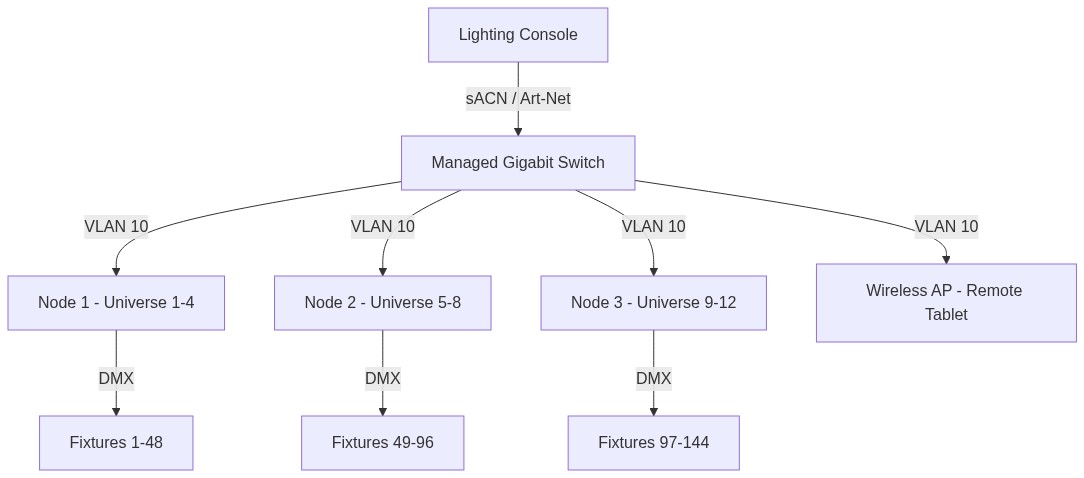
Ethernet Switches
Unmanaged Switches
Unmanaged switches forward all traffic to all ports (or learn MAC addresses for unicast), require no configuration, and are appropriate only for very small, isolated lighting networks. They cannot support VLANs, Quality of Service (QoS), or Spanning Tree Protocol (STP). Broadcast storms from sACN or Art-Net can overwhelm an unmanaged switch in large systems.
Managed Switches
Managed switches are the professional standard for entertainment lighting networks. Key features:
| Feature | Purpose | Entertainment Application |
|---|---|---|
| VLANs (802.1Q) | Logical network segmentation | Isolate lighting from audio/video/IT traffic |
| IGMP Snooping | Multicast traffic management | Routes sACN multicast only to subscribing nodes |
| STP / RSTP | Loop prevention, fast recovery | Redundant network paths without broadcast storms |
| QoS | Priority queuing | Lighting traffic prioritized over file transfers |
| Port mirroring | Traffic monitoring | Troubleshooting with packet capture |
Recommended managed switches for entertainment: Cisco SG series, Netgear ProSafe M series, Ubiquiti UniFi, and Luminex GigaCore (purpose-built for entertainment).
VLANs for Lighting Networks
A Virtual LAN (VLAN) partitions a physical switch into multiple isolated logical networks. Traffic on VLAN 10 is invisible to devices on VLAN 20. Standard entertainment VLAN practice:
- VLAN 10: Lighting (sACN, Art-Net, console backup)
- VLAN 20: Audio (Dante, AVB)
- VLAN 30: Video (NDI, SDI over IP)
- VLAN 40: Show control / intercom
- VLAN 99: Management (switch configuration access)
IGMP Snooping
sACN uses IP multicast by default. Without IGMP snooping, the switch floods multicast packets to every port, consuming bandwidth on devices that don’t need it. IGMP snooping causes the switch to track which ports have subscribed to each multicast group and forwards traffic only to those ports. Always enable IGMP snooping on managed switches running sACN.
PoE — Power over Ethernet
PoE delivers DC power over Cat5e/Cat6 cable, eliminating separate power supplies for low-wattage network devices:
- PoE (802.3af): Up to 15.4 W per port — powers DMX nodes, small cameras, intercoms
- PoE+ (802.3at): Up to 30 W per port — powers wireless access points, larger nodes
- PoE++ (802.3bt): Up to 60–90 W — powers PTZ cameras, thin clients
Always verify total PoE budget of the switch against the sum of all connected PoE device requirements.
Ethernet-to-DMX Nodes
Nodes (also called gateways or converters) receive sACN or Art-Net over Ethernet and output one or more DMX512 universes on XLR or RJ45 ports. Node configuration requires:
- Static IP address (consistent with lighting network subnet)
- Universe assignment per output port
- Protocol selection (sACN vs. Art-Net)
- Merge mode if multiple sources are present
Major node manufacturers: ETC Net3 Node, Pathway Pathport, Enttec ODE MK3, CITADEL by Doug Fleenor Design, Artistic Licence Net-Lynx.
Network Security for Lighting
Entertainment networks are increasingly targeted by cyberattacks, and compromised lighting control can disrupt productions or create safety hazards:
- Use a dedicated, physically separate lighting network whenever possible
- Change default usernames and passwords on all managed devices
- Disable unused switch ports
- Use WPA3 encryption on any wireless segments
- Implement VLAN ACLs to prevent cross-VLAN contamination
- Keep switch firmware updated
Wireless Access Points
Tablet-based remote control of lighting consoles (ETC Remote, MagicQ Remote, Hog 4 Remote) requires a wireless AP on the lighting VLAN. Best practices:
- Deploy 5 GHz-only for less interference in crowded venues
- Enterprise-grade APs (Ubiquiti, Cisco Meraki) for reliable roaming
- Dedicated SSID for lighting control, hidden from general venue Wi-Fi
- Pre-show RF survey to identify interference sources
References
ANSI E1.11. (2008). Entertainment technology: USITT DMX512-A — asynchronous serial digital data transmission standard for controlling lighting equipment and accessories (Rev. 2018). ESTA. Free download: tsp.esta.org
ANSI E1.20. Entertainment technology: Remote device management over USITT DMX512. ESTA. Free download: tsp.esta.org
Entertainment Services and Technology Association. (1996). Recommended practice for Ethernet cabling systems in entertainment lighting applications. ESTA.
Entertainment Services and Technology Association. (1999). Supplement to the recommended practice for Ethernet cabling systems in entertainment lighting applications. ESTA.
Huntington, J. (2000). Control systems for live entertainment (2nd ed.). Focal Press.
See Also: