
Rigging Hazards and Overhead Safety for Entertainment Electricians: Drop Zones, Fall Protection, and Load Path Verification
Overhead rigging is one of the highest-risk activities in entertainment. The consequences of errors — a dropped tool, a failed sling, an overloaded structural point — occur directly above workers and audiences with no time to react. Managing rigging hazards is not an afterthought; it is the framework within which all rigging work happens. Domain 1B covers rigging hazard identification and control as core knowledge for the entertainment electrician.
The Drop Zone
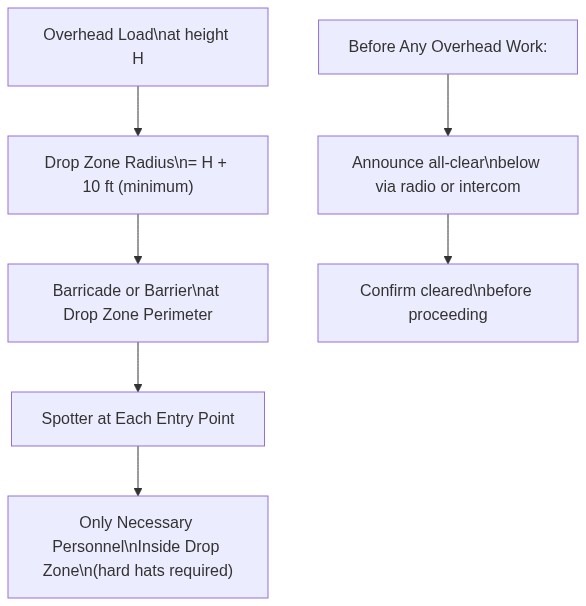
A drop zone is the area directly below and around overhead work where falling objects or a falling load could strike. Every rigging operation must establish a drop zone before work begins. The drop zone perimeter is typically calculated as the height of the work above the floor plus a lateral margin (minimum 10 feet, more for tall loads or swinging loads).
The drop zone must be:
- Communicated: All workers in the area must know rigging work is proceeding overhead. This is typically announced over production radio and confirmed by a crew chief.
- Controlled: The drop zone perimeter is physically barricaded with rope, tape, or hard barriers, and a spotter is positioned at each entry point to prevent unauthorized entry.
- Enforced: Only workers who are necessary for the rigging operation and who are wearing hard hats may be inside the drop zone. Non-essential personnel must wait outside (OSHA, 2015).
During load-in and load-out, when many trades work simultaneously in a large venue, maintaining drop zone discipline requires active management. The rigging crew chief is responsible for ensuring that overhead work and below-work do not occur simultaneously in the same area without controlled coordination (OSHA, 2015).
Tool Control and Dropped Object Prevention
Tools dropped from height can reach lethal velocity before striking a person below. At 20 feet, a 1 lb wrench falls for 1.1 seconds and strikes at approximately 26 mph — enough kinetic energy to cause fatal head injury to an unprotected person. At 50 feet, the same wrench strikes at approximately 41 mph.
Controls for dropped objects:
- Tool lanyards: Every hand tool carried overhead should be on a rated tool lanyard attached to the user’s belt or harness. Tool lanyards are available for screwdrivers, wrenches, pliers, ratchets, and drill motors.
- Buckets and bags: Hardware (screws, clamps, bolts) must be kept in a bucket or tool pouch, never in a pocket that can be emptied by bending over.
- Hard hats: All personnel in or passing through a drop zone must wear hard hats. Class E (Electrical) hard hats are required in entertainment overhead work where energized conductors may be contacted (OSHA, 2015).
- Mesh or solid floor in overhead positions: Catwalks and gallery positions should have mesh floors or deck boards that capture dropped items before they fall to the stage below.
Electrical Hazards Overhead
Entertainment rigging frequently occurs in proximity to energized electrical infrastructure: venue lighting circuits, supply conductors in conduit, cable trays. The NEC specifies minimum working clearances from energized conductors for electrical workers. For voltages up to 300V to ground, the approach distance for qualified workers is 1.0 meter (3.3 feet); for unqualified workers, no approach to energized conductors is permitted (National Fire Protection Association [NFPA], 2021).
Before any rigging work, survey the overhead space for:
- Venue branch circuit conduit or cable tray routed through the work area
- Overhead bus duct or electrical distribution runs
- Power and data cables previously installed from earlier load-in activities
If metallic rigging hardware must pass within the required approach distance of energized conductors, those conductors must be de-energized and locked out before rigging proceeds. Metallic chain, wire rope, and rigging hardware are excellent conductors; contact with an energized conductor with the rigger in the load path creates an electrocution hazard (OSHA, 2015).
Fall Protection
OSHA 29 CFR 1910 (General Industry) requires fall protection for workers at or above 4 feet when there is no safe work surface. OSHA 29 CFR 1926 (Construction) sets the threshold at 6 feet. Entertainment load-in may be classified under either standard depending on jurisdiction and the permanence of the installation. The entertainment electrician must know which standard applies and what fall protection systems are acceptable.
Fall protection options for overhead electrical work:
- Personal fall arrest system (PFAS): Full-body harness, shock-absorbing lanyard, and anchor point rated at 5,000 lb per attached worker. The anchor must be at or above the dorsal D-ring of the harness.
- Positioning device system: Limits fall to 2 feet; must be used with fall arrest when near an unguarded edge.
- Guardrail systems: Fixed guardrails on permanent catwalks and galleries eliminate the need for personal fall protection within the guarded area. Top rail at 42 inches; mid-rail at 21 inches; toe board required to prevent dropped objects.
Load Path Verification Before Energizing
Before a suspended electrical load is energized, the complete load path from structure to fixture must be verified:
- All rigging hardware in the path is within rated WLL for the actual load
- All hardware is correctly assembled (pins moused, locknuts on, cam collars locked)
- Equipment grounding of the suspended electrical equipment is intact through the suspension hardware to the supply cable
- All cables and multi-cables have sufficient slack for the full intended trim travel range without strain on cable connectors
- The drop zone has been cleared and all non-essential personnel are at safe distance
Overhead Rigging Hazard Reference
Occupational Safety and Health Administration. (n.d.). 29 CFR 1910 subpart S: Electrical. U.S. Department of Labor.
Earley, M. W., Sargent, J. S., Sheehan, J. V., & Buss, E. W. (2008). National Electrical Code handbook (11th ed.). National Fire Protection Association.
Jones, R. A., Mastrullo, K. G., & Jones, J. G. (2004). NFPA 70E handbook for electrical safety in the workplace. National Fire Protection Association.
Box, H. C. (2010). Set lighting technician’s handbook: Film lighting equipment, practice, and electrical distribution (4th ed.). Focal Press.
Underwriters Laboratories. (2000). Standard for safety for portable power-distribution equipment (2nd ed.). UL.
Hart, G. V., & Hart, S. (2008). Ugly’s electrical references. Burleson Distributing Corp.
References
Occupational Safety and Health Administration. (n.d.). 29 CFR 1910 subpart S: Electrical. U.S. Department of Labor.
Earley, M. W., Sargent, J. S., Sheehan, J. V., & Buss, E. W. (2008). National Electrical Code handbook (11th ed.). National Fire Protection Association.
Jones, R. A., Mastrullo, K. G., & Jones, J. G. (2004). NFPA 70E handbook for electrical safety in the workplace. National Fire Protection Association.
Box, H. C. (2010). Set lighting technician’s handbook: Film lighting equipment, practice, and electrical distribution (4th ed.). Focal Press.
Underwriters Laboratories. (2000). Standard for safety for portable power-distribution equipment (2nd ed.). UL.
Hart, G. V., & Hart, S. (2008). Ugly’s electrical references. Burleson Distributing Corp.
See Also:
- Working Load Limits and Safety Factors for Entertainment Overhead Rigging
- An overview of OSHA 1926.502: Fall Protection Standards and The Application in the Theater and Entertainment Industry
- Calculating Weight Distributions of Overhead Electrical Equipment for Entertainment Rigging
- Chain Hoists and Mechanical Advantage Systems for Entertainment Overhead Rigging