
Specialized Environmental Applications for Entertainment Electrical Systems: Weather, Damp, Wet, and GFCI
Entertainment productions operate in every environment imaginable: outdoor summer festivals in thunderstorms, winter arena tours in sub-zero loading docks, underwater effects stages, and rooftop venues exposed to coastal humidity. Each environment presents specific electrical hazards that must be addressed through correct equipment selection, weatherproofing methods, and protection systems. Domain 1C covers the ability to recognize location classifications and apply the appropriate NEC and OSHA requirements for each.
Location Classification
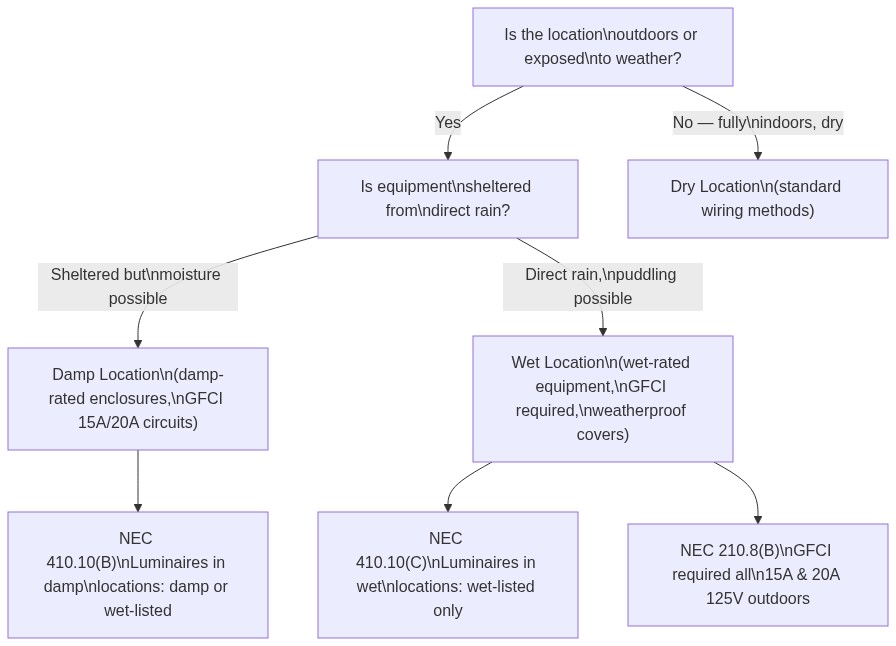
The NEC classifies locations as dry, damp, or wet, and requires that electrical equipment be listed and installed for the actual location class (National Fire Protection Association [NFPA], 2023):
- Dry locations are protected from weather and not subject to saturation with water or other liquids. Standard indoor venues — theaters, arenas, convention centers — with intact roofs and walls are dry locations.
- Damp locations are partially protected from weather: covered stages, loading docks, covered outdoor pavilions, and similar locations where direct exposure to rain is prevented but moisture can accumulate. Equipment in damp locations must be listed for damp or wet locations.
- Wet locations are exposed to weather, saturation, or submersion: outdoor festival stages, open-air amphitheaters, rain stages, and any location where standing water or direct precipitation is possible. Equipment in wet locations must be listed for wet use, and all connectors must be rated for wet locations. Using equipment rated only for dry or damp locations in a wet location is a code violation and a safety hazard (NFPA, 2023).
Weather Protection for Electrical Equipment
At outdoor events, portable distribution equipment designed for touring (dimmer racks, PDUs, relay racks) is generally rated for indoor use. Moving it outdoors requires weather protection:
- Road cases with covers: Equipment operated in its road case with the lid closed and weatherproof cable entry openings is reasonably protected from rain in most conditions. Cable entry points must be sealed against water infiltration — water that enters and pools inside a dimmer rack creates both a shock hazard and equipment damage.
- Tent or canopy cover: For extended outdoor events, equipment tents or awnings provide overhead protection. The tent must be positioned so that water runoff does not flow through the equipment area. All electrical equipment must be elevated off the ground to prevent flood water intrusion.
- Weatherproof connectors: All outdoor connections must use connectors and covers rated for wet locations. Camlok connectors are inherently rain-resistant due to their locking cam design, but should not be left lying in puddles. Stage pin connectors used outdoors must use listed weatherproof covers when not connected. NEMA twist-lock and IEC 60309 connectors designed for wet use are available and must be used in wet locations (NFPA, 2023).
GFCI Protection
Ground fault circuit interrupter (GFCI) protection is one of the most important safety systems for entertainment work in wet and damp environments. A GFCI monitors the difference in current between the hot and neutral conductors of a circuit. If more than 4–6 mA of current is “missing” — flowing to ground through a person or a fault rather than returning through the neutral — the GFCI trips within 25 milliseconds, interrupting power before a potentially lethal shock can develop.
| NEC Location | GFCI Required For | NEC Reference |
|---|---|---|
| Outdoor (residential & commercial) | All 15A and 20A, 125V receptacles | NEC 210.8(A)(3), 210.8(B) |
| Bathrooms | All receptacles | NEC 210.8(A)(1) |
| Kitchens (within 6 ft of sink) | All countertop receptacles | NEC 210.8(A)(6) |
| Garages and accessory buildings | All 15A and 20A, 125V receptacles | NEC 210.8(A)(2) |
| Wet bar sinks (within 6 ft) | All receptacles | NEC 210.8(A)(7) |
| Construction sites (temp power) | All 125V receptacles up to 30A | NEC 590.6(A) |
| Entertainment (NEC 525, carnivals) | All 15A and 20A, 125V receptacles not part of a listed assembly | NEC 525.23 |
NEC 525.23 specifically addresses carnivals, circuses, fairs, and similar events, requiring GFCI protection for all 15A and 20A, 125V receptacles not part of a listed assembly. Most entertainment touring productions reference this article for their outdoor electrical setups. The practical interpretation: all portable outlets used to supply equipment at outdoor entertainment events must be GFCI-protected (NFPA, 2023).
GFCI devices must be tested before each use. A GFCI that trips on the test button but does not reset, or that does not trip when tested, must be replaced immediately. GFCI protection does not protect against line-to-line faults (phase-to-phase, 208V or higher) — it only detects current imbalance between hot and neutral. For two-wire 240V loads, a GFCI provides no protection.
Rain and Moisture Management at Live Events
When rain occurs during a live event, specific procedures apply:
- Assess water intrusion: Inspect all electrical equipment for water accumulation. A dimmer rack with standing water inside must be de-energized and not re-energized until the water is removed and the equipment is dry and inspected.
- Check GFCI protection: Verify that all circuits feeding equipment exposed to rain are GFCI-protected. If they are not, de-energize those circuits until GFCI protection can be added or the equipment is protected.
- Protect connection points: Cover all outdoor connector connections that are not currently mated. A stage pin female left open in rain collects water; connecting a stage pin into a water-filled receptacle creates a shock hazard.
- Consider de-energizing performer areas: If rain is reaching the stage performance surface, performer microphone and instrument power circuits should be evaluated for GFCI protection. Performers holding microphones or touching grounded instruments while standing in water are at risk of electric shock through the audio ground system (NFPA, 2023).
Cold Weather Electrical Considerations
Cold temperatures affect entertainment electrical systems in ways that must be planned for:
- Cable flexibility: Standard SJTW thermoplastic cable becomes stiff and difficult to manage below about 0°C (32°F). SOOW rubber cable remains flexible at temperatures down to approximately −40°C (−40°F) and is the correct choice for cold outdoor events.
- Equipment cold-start: Some dimmer racks and electronic equipment specify a minimum operating temperature. Starting equipment from cold can cause condensation inside the enclosure as the electronics warm up. Allow equipment to warm to operating temperature before loading circuits.
- Battery backup (UPS) capacity: UPS battery capacity is reduced at low temperatures. A UPS specified for 10 minutes of runtime at 20°C may provide significantly less runtime at 0°C.
References
Earley, M. W., Sargent, J. S., Sheehan, J. V., & Buss, E. W. (2008). National Electrical Code handbook (11th ed.). National Fire Protection Association.
Jones, R. A., Mastrullo, K. G., & Jones, J. G. (2004). NFPA 70E handbook for electrical safety in the workplace. National Fire Protection Association.
Occupational Safety and Health Administration. (n.d.). 29 CFR 1910 subpart S: Electrical. U.S. Department of Labor.
International Association of Electrical Inspectors. (2001). Soares book on grounding (8th ed.). IAEI.
Box, H. C. (2010). Set lighting technician’s handbook: Film lighting equipment, practice, and electrical distribution (4th ed.). Focal Press.
Hart, G. V., & Hart, S. (2008). Ugly’s electrical references. Burleson Distributing Corp.
See Also:
- Branch Circuit Wiring for Entertainment Electrical Systems: Sizing, Routing, and Testing
- ETCP Electrician Exam 1C: Setting Up Entertainment Electrical Systems
- ETCP Electrician Exam 3C: Determining Specifications for Entertainment Electrical Systems
- ETCP Electrician Exam 3D: Documentation for Entertainment Electrical Systems