
Structural Attachment Points for Entertainment Overhead Rigging: Beam Clamps, Eye Bolts, and D-Rings
Every piece of overhead electrical equipment eventually traces its load path to the building structure — or to a ground-supported structure, which itself sits on the building’s floor. The points where rigging hardware attaches to the building are structural attachment points, and they are often the least understood and most under-documented element of an entertainment rigging system. An ETCP-certified entertainment electrician must understand the types of structural attachment points, their selection criteria, and their limitations.
The Load Path Concept
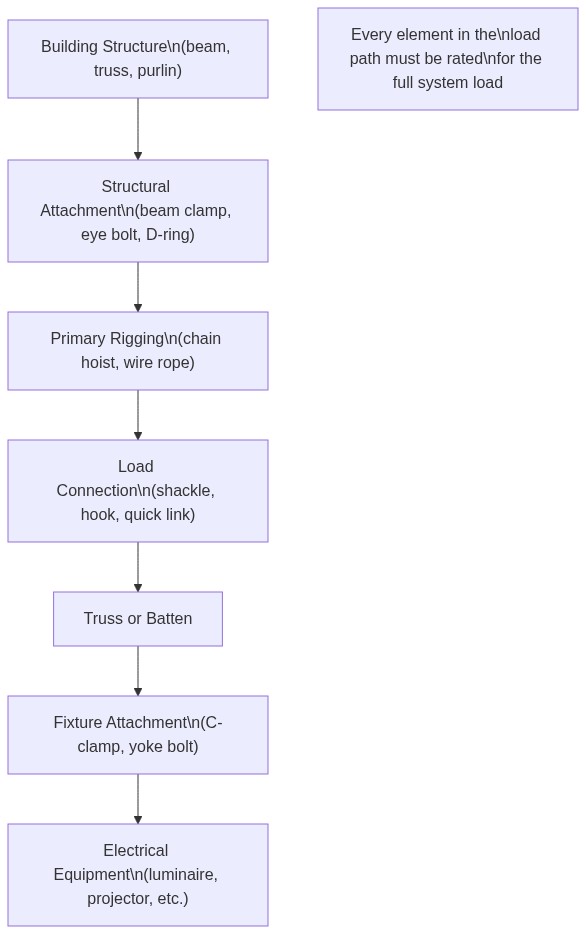
Every rigging system forms a load path: a continuous mechanical chain from the structural attachment point to the electrical equipment being supported. Every element in the load path — building structure, attachment hardware, primary rigging, load connectors, batten or truss, fixture attachment, and the fixture itself — must be capable of supporting the full load. Failure at any point in the path causes the entire system to fail (ANSI E1.6-1, 2022).
The entertainment electrician is responsible for the elements below the chain hoist hook — the fixture and its attachment to the batten. However, understanding the complete load path is essential for recognizing when a system is at or near its limit and when to escalate to a rigger or structural engineer.
Eye Bolts
A shoulder eye bolt is a threaded fastener with a circular loop (eye) at its head, installed through a steel plate, beam web, or other structural member. The shoulder — the collar between the eye and the threads — must bear fully against the mounting surface when installed. An eye bolt without a shoulder, or with the shoulder lifted off the surface, loses most of its rated load capacity.
Angular loading derating: Eye bolts are rated for straight-line pull (axial loading — directly through the bolt’s axis). When a sling or chain pulls at an angle, the WLL is reduced substantially:
- At 45° from the bolt axis: reduce WLL by 30%
- At 90° (side pull): reduce WLL by 75%
When angled loading is anticipated, a swivel hoist ring (also called a rotating shackle or pivoting eye) should be used instead of an eye bolt. Swivel hoist rings pivot to align with the load direction without derating (OSHA, 2015).
Beam Clamps
Beam clamps grip the flange of a structural steel I-beam or H-beam from below. A threaded bolt passes through the clamp body and bears against the top of the beam flange; the clamp body hooks over the flange edge. The clamp must be selected to match the flange width — the bolt must contact the flange surface, not the flange edge. Most beam clamps are rated for vertical loads only; side-loaded beam clamps are a special design.
Before installing a beam clamp, verify:
- The clamp’s WLL meets or exceeds the rigging load at that point
- The beam flange is within the clamp’s specified width range
- The beam itself is rated for the applied load at that point (a structural engineer or the venue rigging plot provides this information)
- The bolt is torqued per the clamp manufacturer’s specification and secured with a lock nut or jam nut
Purlin Clamps
Structural purlins — horizontal C-channel or Z-section members that span between main beams — are common attachment points in large-span venues (arenas, convention centers). Purlin clamps grip the web and flanges of the purlin. As with beam clamps, the clamp must match the purlin geometry, and the purlin must be verified to carry the applied load. Purlin loads in entertainment should always be reviewed by the venue’s structural engineer of record or a qualified rigger before installation (ESTA, 2019).
D-Rings and Truss Attachment Points
D-rings and rated attachment plates are installed on trusses by the truss manufacturer at specified intervals and locations. They are rated for a defined load capacity per the truss design documentation. Only manufacturer-specified attachment points on a truss should be used for hanging loads; attaching to unrated locations (top chord, diagonal webs) may overload members not designed for the applied moment.
When to Consult a Structural Engineer
Entertainment rigging attachments to building structures should always be based on documentation from the venue — a rigging plot showing approved attachment points with rated capacities. When no documentation exists, or when loads exceed documented capacities, a licensed structural engineer must evaluate the structure before rigging proceeds. This is not optional: ANSI E1.6-1 requires that structures used for powered entertainment hoisting systems have engineer-verified capacities (ESTA, 2019). The entertainment electrician should never assume that a structure is adequate for a load without verification.
Attachment Point Reference
Occupational Safety and Health Administration. (n.d.). 29 CFR 1910 subpart S: Electrical. U.S. Department of Labor.
Earley, M. W., Sargent, J. S., Sheehan, J. V., & Buss, E. W. (2008). National Electrical Code handbook (11th ed.). National Fire Protection Association.
Jones, R. A., Mastrullo, K. G., & Jones, J. G. (2004). NFPA 70E handbook for electrical safety in the workplace. National Fire Protection Association.
Box, H. C. (2010). Set lighting technician’s handbook: Film lighting equipment, practice, and electrical distribution (4th ed.). Focal Press.
Underwriters Laboratories. (2000). Standard for safety for portable power-distribution equipment (2nd ed.). UL.
Hart, G. V., & Hart, S. (2008). Ugly’s electrical references. Burleson Distributing Corp.
References
Occupational Safety and Health Administration. (n.d.). 29 CFR 1910 subpart S: Electrical. U.S. Department of Labor.
Earley, M. W., Sargent, J. S., Sheehan, J. V., & Buss, E. W. (2008). National Electrical Code handbook (11th ed.). National Fire Protection Association.
Jones, R. A., Mastrullo, K. G., & Jones, J. G. (2004). NFPA 70E handbook for electrical safety in the workplace. National Fire Protection Association.
Box, H. C. (2010). Set lighting technician’s handbook: Film lighting equipment, practice, and electrical distribution (4th ed.). Focal Press.
Underwriters Laboratories. (2000). Standard for safety for portable power-distribution equipment (2nd ed.). UL.
Hart, G. V., & Hart, S. (2008). Ugly’s electrical references. Burleson Distributing Corp.
See Also:
- Calculating Weight Distributions of Overhead Electrical Equipment for Entertainment Rigging
- Chain Hoists and Mechanical Advantage Systems for Entertainment Overhead Rigging
- Codes and Standards for Overhead Rigging in Entertainment: ANSI E1.6-1, OSHA, and Venue Requirements
- Equipment Hanging Techniques for Entertainment Rigging: Clamps, Motors, Trusses, and Counterweight Systems